Subscribe to our Telegram channel!
NASA scientists start testing a unique drone that will explore space

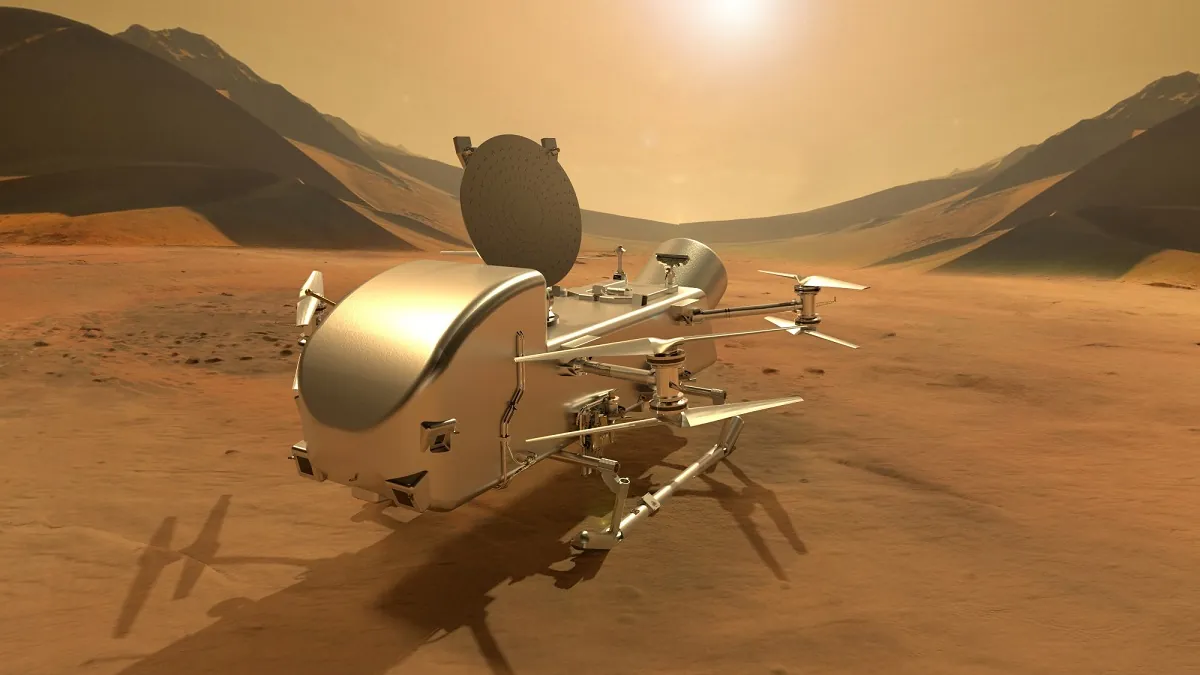
NASA researchers led by scientists from Johns Hopkins University’s Applied Physics Laboratory (APL) have conducted the first tests of the Dragonfly model, a nuclear-powered drone designed to study Saturn’s largest moon, Titan. The half-scale model was tested in a wind tunnel to understand how its future large-scale copy will perform in Titan’s unique liquid environment.
Mission engineers conducted two tests in NASA’s 4.5 m by 6.7 m subsonic tunnel at Langley and two more in the five-meter transonic tunnel (TDT). The first facility is used to test the aerodynamics and hydrodynamics of various drone models, while the TDT is designed to simulate different atmospheric conditions using gases of different densities.
According to test manager Bernadine Giuliano of APL, the tests focused on two flight configurations: a vertical descent to Titan and a forward flight over its surface. «We tested the conditions in expected flight scenarios at different wind speeds, engine speeds and flight angles to evaluate the aerodynamic performance of the vehicle. We performed more than 700 runs covering more than 4000 individual data points. All test objectives were successfully met, and the data obtained will increase confidence in our models on Earth when we send a mission to Titan.»
The TDT tests helped to provide insight into how Dragonfly engines will perform in Titan’s exotic atmosphere. «The density of gas in TDT is three and a half times higher than that of air at atmospheric pressure and temperature at sea level. This allows the rotors to operate in conditions close to Titan,» said Rick Heisler, head of the TDT test company.
Now NASA and APL experts are analyzing the test data together with partners from the University of Central Florida, Pennsylvania State University and Lockheed Martin.
As a reminder, NASA scientists are seeking to explore life on the moons of Jupiter and Saturn. To do this, they are designing floating robots that will search for extraterrestrial organisms there. One of the necessary robots for this mission may be SESAME. This is a type of «thermomechanical drilling robot» that can tunnel through a thick ice shell, which in some places reaches 25 km.