Subscribe to our Telegram channel!
Cryptocurrency settlement using artificial intelligence is available on the Ethereum blockchain

Ethereum has announced the launch of a new open standard, ERC-8183, which allows artificial intelligences to make cryptocurrency payments for completed tasks without human intervention. This solution is an important step in the development of the agent economy, an environment where programs negotiate with each other, perform work, and make payments through smart contracts.
The protocol was created by the Virtuals Protocol team together with the Ethereum Foundation’s dAI division. Its main feature is conditional payments through escrow contracts: funds are blocked as soon as the agreement is created and released only after the task is confirmed. This eliminates the need for trust between agents or the use of centralized platforms.
ERC-8183 introduces the key abstraction «Job», which defines three roles: customer, contractor, and evaluator. The evaluator can be a smart contract, another agent, or multi-signature logic. It is the evaluator who decides whether the work has been completed properly, after which the funds are automatically transferred or returned to the customer.
The new standard integrates with other elements of the Ethereum infrastructure, such as the x402 micropayment protocol and the ERC-8004 identity and reputation standard. Together, they form the basis for an agent-based economy, where each transaction becomes proof of reliability and contributes to the formation of a reputation system. This is basically programmable commerce without centralized intermediaries.
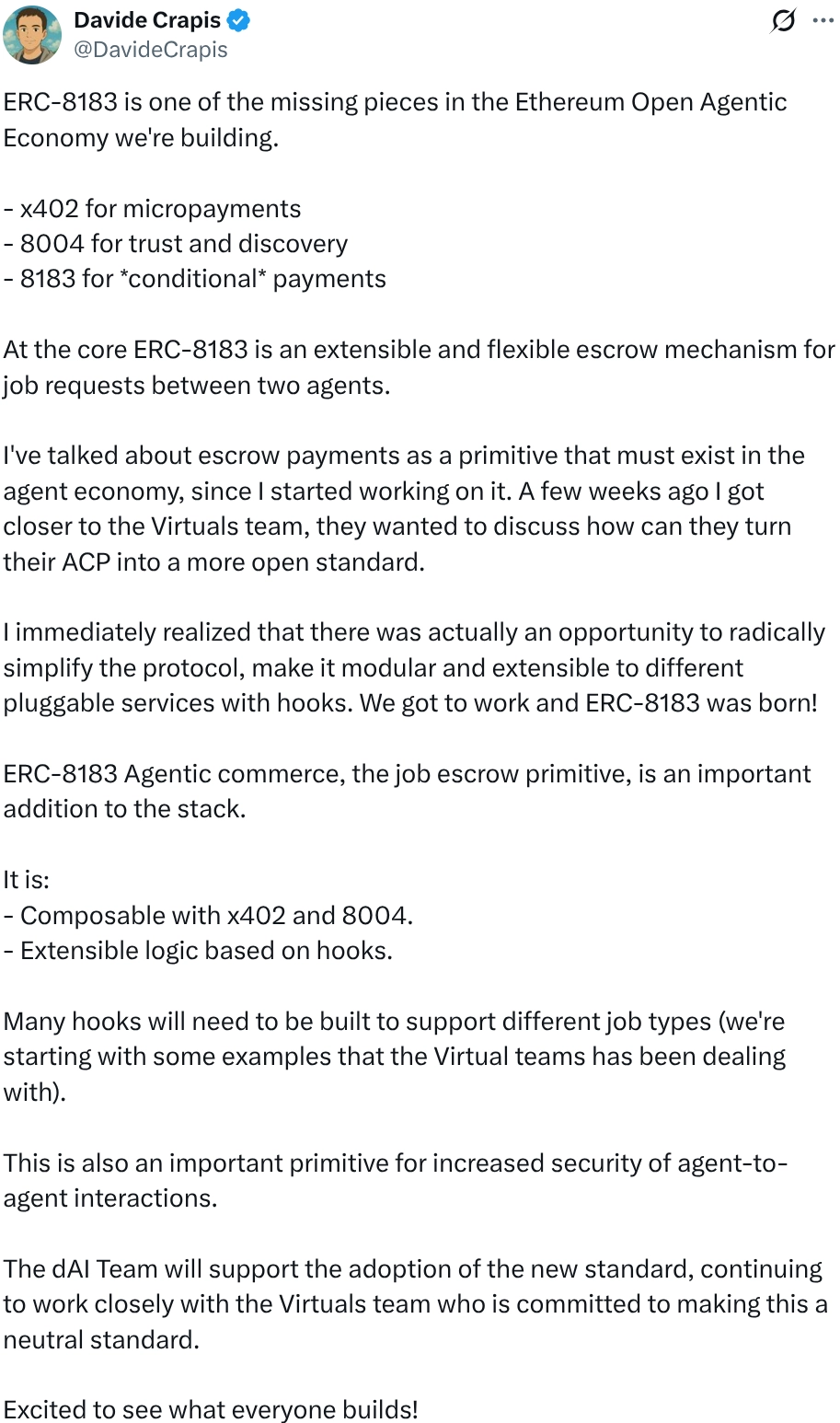
According to Davide Krapis of the Ethereum Foundation, ERC-8183 is the «missing element» in the creation of an open agent economy. Analysts believe that trust between autonomous programs without human intervention is the main barrier to the development of Web3, and the new protocol offers a solution that makes transactions verifiable, secure, and fully autonomous. This could be a key milestone in the establishment of the machine-to-machine economy.