

Subscribe to our Telegram channel

For the first time in history, scientists have managed to study the anatomy of a dead star in space
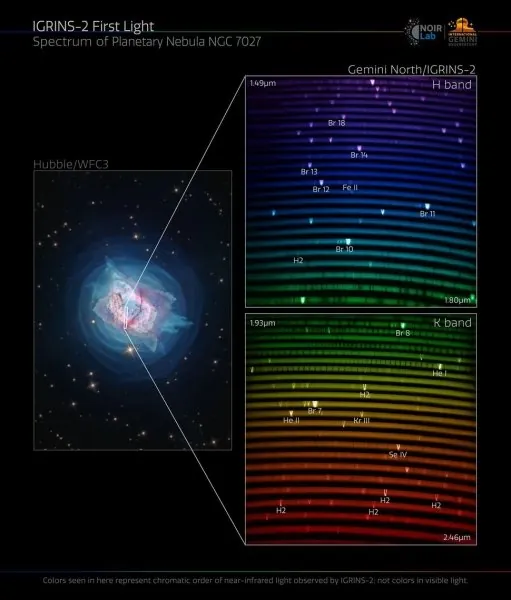
For the first time in scientific practice, astrophysicists have used the new IGRINS-2 spectrograph installed on the Gemini Observatory telescope to detect the chemical elements of a dead star. Scientists say that these elements make up the planetary nebula NGC 7027 called the «Precious Beetle». Thanks to the new spectrograph, astronomers were able to look behind the curtain of cosmic dust, through which visible light does not penetrate. This is reported by Space.
Scientists have made the first observation using the new IGRINS-2 spectrograph, which can observe space in the near-infrared range of light, invisible to the human eye. Thanks to the new instrument, the researchers were able to look through the veil of cosmic dust that envelops the planetary nebula NGC 7027, located at a distance of 3 thousand light years from Earth. As a result, new data were obtained on the chemical composition of the nebula, which corresponds to the composition of the star that created it.
In particular, with the help of the IGRINS-2 spectrograph, scientists have detected isotopes of bromine, helium, iron, krypton and selenium, as well as a large amount of molecular hydrogen.
«Planetary nebulae are a cloud of gas and dust that surrounds a white dwarf star.This star and the nebula itself appeared as a result of the death of a Sun-like star, when it first threw its upper layers into space and then shrank to a small size,» the scientists said.
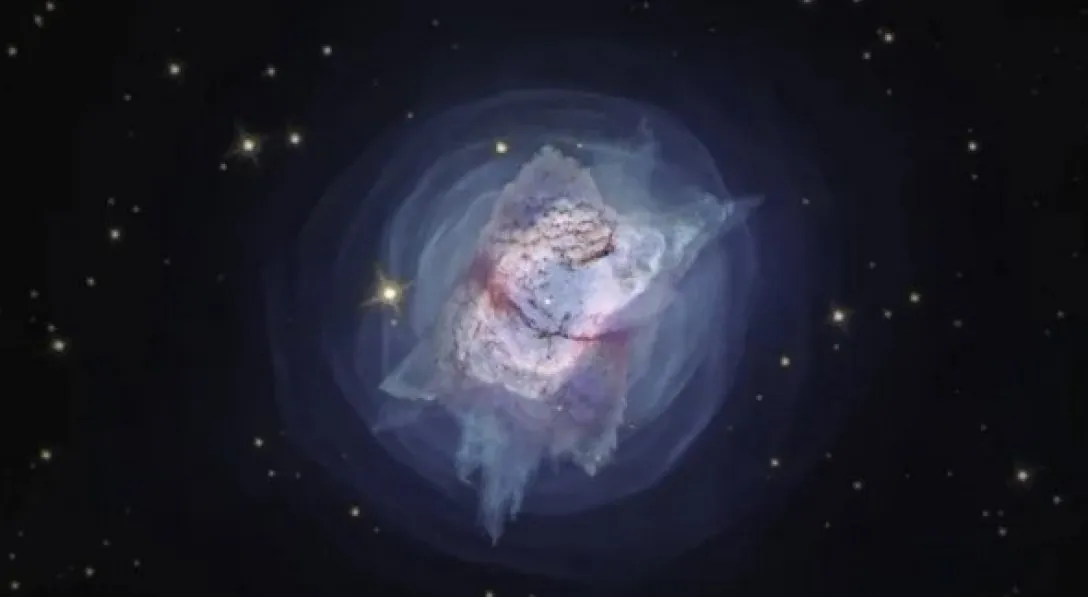
The IGRINS-2 spectrograph separates light into its component wavelengths, which helped scientists to understand the chemical composition of the planetary nebula.
Once astrophysicists are convinced that the spectrograph is working properly, they aim to use it to study various objects in space. In particular, it will be used to observe regions of new star formation, as well as similar planetary nebulae, which are the remnants of dead stars.
Scientists also intend to study exoplanets, brown dwarfs, and distant galaxies that are hidden by cosmic dust. The researchers are confident that since the IGRINS-2 spectrograph can look into opaque regions of the Universe, they will better understand how stars are born and various astronomical phenomena hidden by cosmic dust.
Earlier, we told you that for the first time, scientists managed to take an X-ray of a star cluster in space. Astronomers have uncovered the secrets of one of the most amazing pulsar nebulae, MSH 15−52, also known as the «cosmic hand» or «hand of God». With the help of two powerful X-ray telescopes, scientists were able to visualize the «bones» in the ghostly hand, which consists of magnetic fields. NASA’s Chandra X-ray Observatory and the Imaging X-ray Polarimetry Explorer (IXPE) were used in the study.