Subscribe to our Telegram channel!
Scientists have developed a camera that works like the retina of the human eye

Engineers from the University of Pennsylvania have developed a camera that works like the retina of the human eye. Three types of «photoreceptors» mimic the retina, and an artificial neural network processes the images.
The device is based on a sensor matrix of narrow-band perovskite photodetectors that mimic the cones of the retina. The matrix is connected to a neuromorphic algorithm that mimics a neural network to process information and obtain images with high accuracy.
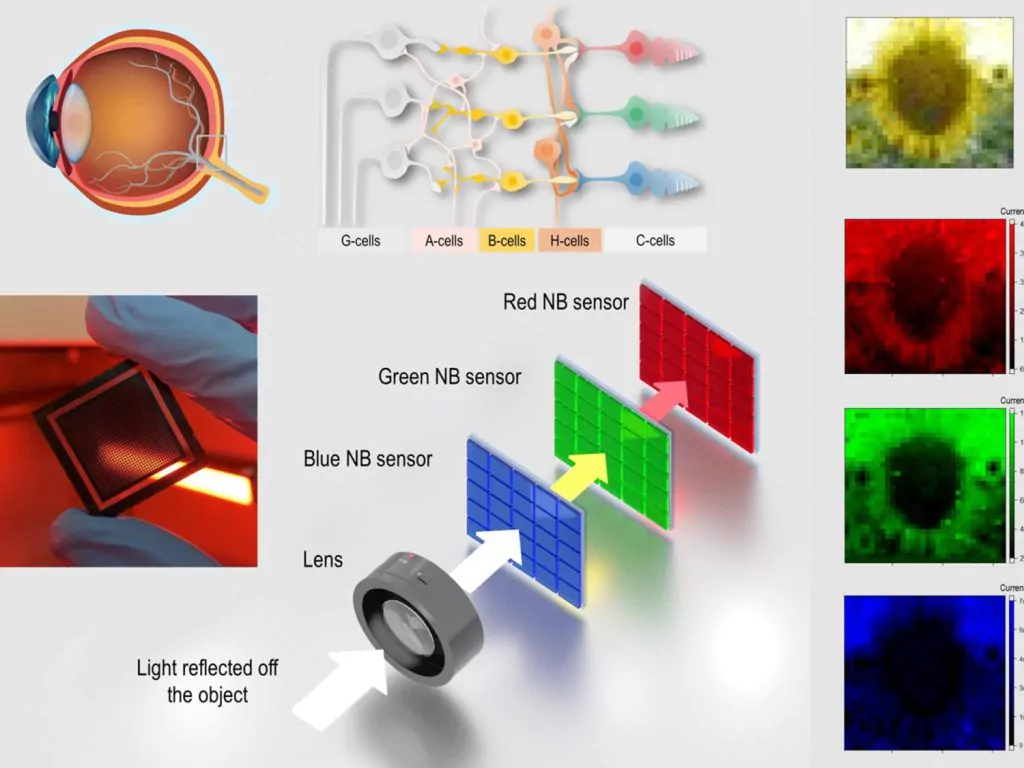
Researchers believe that this new type of sensor can be used as an alternative to filters in modern cameras. Silicon sensors are sensitive to all parts of the spectrum, so light filters are installed in front of them, which transmit only certain waves, but they reduce the clarity and sensitivity of the camera.
«We borrowed the design from nature — our retinas contain cones that are sensitive to red, green, and blue light, and a neural network that starts processing what we see before the information is transmitted to our brains. This natural process creates a bright world that we can see ,» explained Kai Wang, co-author of the invention.
In addition, the technology opens up the possibility of creating artificial retinas for people with visual impairments. Since perovskite elements generate electricity under the influence of light photons, such a surface does not require an additional power source and can function autonomously.
In early March, Prophesee, a camera chip startup, announced a multi-year collaboration with Qualcomm. The main goal of the collaboration is to improve the performance of smartphone cameras using Prophesee chips. The technology behind Prophesee chips is inspired by the way the human eye works. The camera in a smartphone will use the logic of human vision to highlight certain accents, such as moving and stationary objects, light angle, etc.