Subscribe to our Telegram channel!
Scientists discover a planet that should not have existed

A group of South Korean astronomers has discovered a planet 8 UMi b that weighs about the same as Jupiter and has an orbital radius smaller than the distance from the Earth to the Sun. The planet was named Hulla, after a peak in South Korea. The cosmic body orbits the giant star Baekdu, which is larger than the Sun and is located in the constellation of the Little Bear.
Astronomers believe that Hulla somehow survived after its star went through a difficult stage of evolution that could have been dangerous for neighboring planets and even led to their destruction.
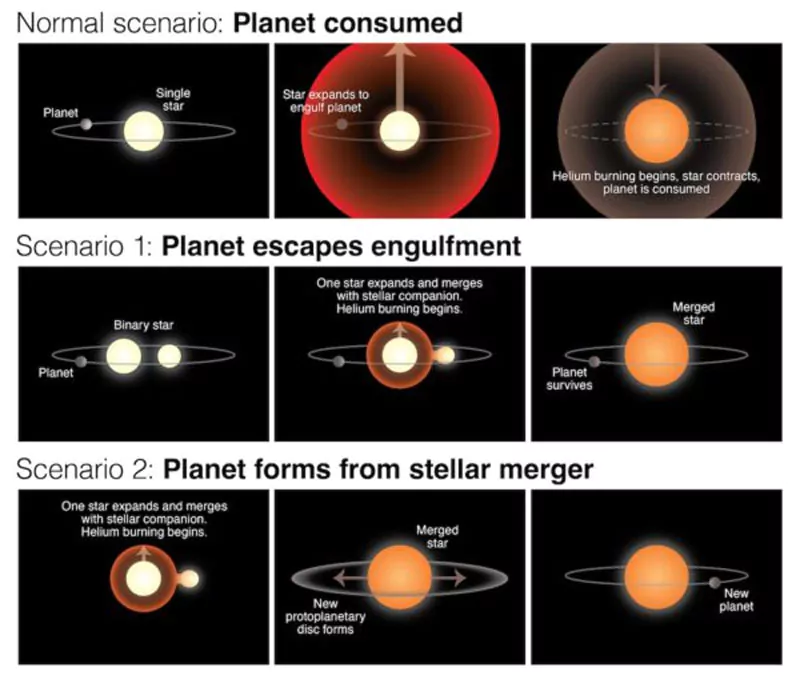
The observations were made using the NASA Transiting Exoplanet Survey Satellite. The study showed that the star is still burning due to a significant supply of helium in its core. Scientists also believe that it has already exhausted all its hydrogen. This leads astronomers to believe that Bekdu once expanded into a red giant.
«Being swallowed by a star usually has catastrophic consequences for planets in close orbits. When we realized that Hala had survived in the immediate vicinity of its giant star, it came as a real surprise to us. As it exhausted its hydrogen fuel, the star would have swelled to 1.5 times the orbit of the planet, completely engulfing it before shrinking to its current size,» said study co-author Dr. Dan Huber.
Now astronomers are trying to determine how the planet managed to survive. Scientists emphasize that if such a scenario ever happens to the Sun, then Mercury, Venus, and Earth will be destroyed.
In the meantime, the solar system is not in danger, and the National Aeronautics and Space Administration (NASA) has planned mining on the Moon. At the initial stage, water and oxygen production will be ensured, followed by the development of iron and rare earth metals. The agency plans to assess the potential volume of lunar resources to attract commercial investment in the project.